Showing posts with label Comics. Show all posts

Wednesday, March 06, 2013

Finding Superman

I've had an affection for Superman going back to childhood.  I've never really attempted to formally articulate the basis for my admiration, but I think it's for the same reasons most people love the character.  Over the past 20 years, the comic book industry has become decidedly more adult and less kid friendly.  During that same time, Superman has increasingly come to be viewed as a square; the Richie Cunningham to Batman's Fonz.  DC has done little to alter that perception and seems to be increasingly confused about what to do with their flagship character.  I've griped and carped about this a few times without ever getting specific.  And now I don't have to.  Ryan over at The Signal Watch, my go-to Superman expert,  has done a masterful job reminding us why we love the character, as well as explaining the reasons for Superman's current place in the wilderness and what could be done to fix it.  Here are some highlights:

On Superman's supporting cast
There's a big focus in superhero comics these days wherein they characters only spend time with other superheroes after the origin story.  The Avengers only really talk to one another and SHIELD agents.  Batman only talks to Alfred and his cadre of masked young men, and Superman - even in the relaunch - only seems to talk to his 5th Dimensional neighbor and the Legion of Superheroes.

It sort of raises the question: what are any of these characters doing?  What are they fighting for?  What is the point of going out and putting on a cape if everyone you know is wearing the suit? 

I don't think Marvel had anything to lose in dumping the secret ID's of Captain America and Iron Man as those characters don't really need to hide their identity.  They're soldiers and captains of industry running around with personal arsenals.  Superman, however, isn't about tactical superiority, necessarily.  He's among us.  He's one of us.  Sure he took a job where he could be a crusading journalist by day to cover the news and understand the world (not it in his apartment and blog about stuff he saw on Reddit), but he's an alien who has a need to connect and share.  He made friends at The Planet, and that dynamic gave weight and import to the stories as something other than just people in tights punching one another.  He lived among us, and when we needed him, he stepped out of view long enough to change clothes and come save the day 

In so much of what you see in comics now, I have absolutely no idea what would be lost if the characters lost the day.  It's all secret ninja fights in dark alleys based on petty grudges.  Superman can be that from time-to-time, but the specialness of what a superhero is doing is dramatized not in another splashy spread on the page but in how that character is different from the unique personalities that surround him or her and what it means to be both friend and protector of that community.

On Superman as a socially conscious hero
Superman, when he was the only character in town, was unique as a sort of Robin Hood who didn't need to worry about getting arrested or beaten/ shot if he resisted while he went about doing what was right.  This went both ways, as we see in the first issue of Action where Superman defies the very governor of his state and saves someone about to be executed, and later takes on gangsters.  Both sides wield power, legitimate or otherwise, and Superman is beyond mortal concern when it comes to taking a stand or sticking up for the people who can't help themselves. 

For kids' stories, it's all pretty straightforward, but as comic shave grown into a medium for older readers, the better Superman stories explore what the implications are for exerting that power, and what effects it has from an intended and unintended standpoint.

On Lois Lane
She's also an integral part of why Superman needs Clark and needs to appear human. It's the only way to stick close to this remarkable woman until he can figure out how to better integrate his two lives.  Lois is the touchstone to what he sees in humanity that's worth saving - the spark of righteous indignation at injustice, the desire to set things right - it's what sets him out there in the cape and tights, to be the person to be the change that Lois wants to see.

On who Superman is
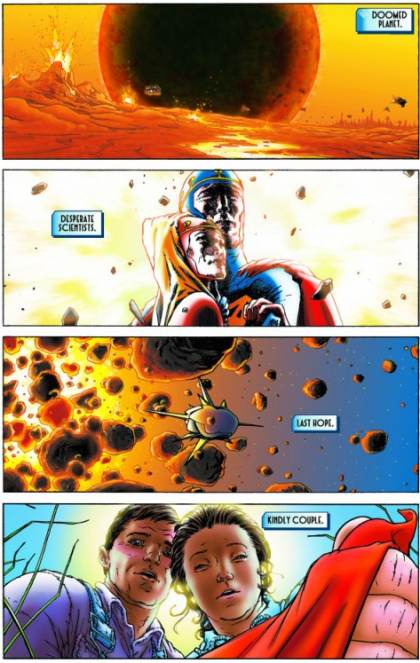
In my book, Superman is - in many ways - who Clark would be if he'd just been the human child of Martha and Jonathan Kent.  Likely, he'd be a reporter who was maybe a bit overly persistent in his pursuit of investigative journalism.  Superman may be smarter than that guy, and more damage resistant, but the core of who Superman is was set in his years between 1 and 18 by Jonathan and Martha. 

But he wasn't that human child, and at some point he knew he was so different he became withdrawn, and the Clark Kent that we know was made - still with Jonathan and Martha's principles, but not sure how to deal with his classmates.  How do you talk about the fact you coughed and knocked over a barn wall? That you accidentally saw Lana's underwear with your X-ray vision?  That if someone pushes you in the hall, they're going to be pushing against a stone pillar?

Learning that he's Kal-El is freeing.  It explains so much, but it also creates a new sense of responsibility for a whole culture, like suddenly learning he's a foreign exchange student from a country nobody really knows. 

On Superman's audience
Yeah, Superman isn't for kids blasting Nu-Metal from their iPhone.  Comics are full of characters for that demographic, and trying to make Superman work for the same audience that came to comics for The Punisher, Venom, Spawn, and (I hate to say it) Batman isn't going to work very well. 

At this point in American pop-culture, Superman is seen as an Uncle who goes around telling kids to brush their teeth and get good grades, and that's square as hell, man. I'm not sure he was every actually like that in any medium, but I'm not going to deny the perception is out there. 

Superman can be an aspirational character and not just a character who makes us comfortable wallowing in self-pity.  It doesn't matter that he's  incredibly powerful. Complaining that you can't imagine someone more powerful than Superman or who could challenge Superman says more about your lack of imagination as a writer than it does about 75 years of people who have given it a shot and succeeded. 

What I don't think Superman needs is a killer edge to appeal to the audience that DC is courting.


Well said, Ryan.  (Read his enitre post here).

Wednesday, October 10, 2012

Looking back: The Dark Knight Returns

Nineteen eighty-six is considered to be a seminal year in superhero comics, both in terms of quality and creativity.  Alan Moore's Watchmen hit stands.  John Byrne rebooted Superman in the The Man of Steel miniseries.  Frank Miller penned the magnificent Born Again storyline in Daredevil. But none more influential on pop culture or the future of superhero comics than The Dark Knight Returns.  It is widely considered to be among the finest superhero comics ever written.  What else can be said without invoking hyperbole?  The Dark Knight Returns wasn't the first comic written for a more mature audience, but it's certainly the marker laid down for when superhero comics evolved to include darker, more violent and intelligent content (the last has often been discarded in favor of the first two in the years since).

For those who have yet to read TDKR, it takes place in Gotham City of the near future, perhaps ten years or so (from 1986). Superheroes have been outlawed, although it's unclear exactly why, something to do with a series of incidents that caused the public to become more fearful and distrustful of them). The government has become more powerful and authoritarian (Reagan is still holding onto the presidency).  The United States in is still in the midst of the Cold War and tensions with the Soviets are nearing a breaking point.  As the story begins, Batman has been retired for ten years.  His enemies are safely locked up, but Gotham is worse than ever.  A gang calling themselves the Mutants are terrorizing the city.  Batman comes out of retirement to deal with them.  But this Batman is older, meaner, and even more inclined to break the law.  Lined up against him is not only the mutant gang, but the media and the public.  As his war in Gotham escalates, it gets the attention of the federal government who dispatches Superman to deal with him.

The art is solid, if unspectacular and looks very unlike his artwork before or since.  His lines are thin and numerous with a sketchy look to them.  This is only enhanced by Klaus Janson, who takes a minimalist approach to inking. Lynn Varley's colors look like watercolor, very washed out but distinctive since the comic is very gray throughout. Visually, the book's strength is Miller's masterful panel by panel storytelling.  The pages have a distinctly cinematic look, and he is able to effectively create pace, drama and action throughout.

The story does a great job of satirizing the shallow media-saturated culture of the 1980s that has only gotten worse in the years since, which is a big part of why the book is still compelling.  But it doesn't stop there.  Miller explores a number of themes, including the limits of law and order, vigilantism, freedom vs. security, chaos vs. order, anarchy, fascism, political correctness, the responsibility of individual citizens to maintain justice, the cost of compromising your values.  The story asks what does it look like to be good in terrible world?  Can we escape who we really are?  Does violence, even if it's for a good cause, create more violence?

What I appreciate most is that Miller doesn't seem to come down hard on any side of these issues.  For example, his wonderful satirizing of pop psychology in the character of Dr. Wolper. On the one hand, Miller mocks the psycho-babble Dr. Wolper dispenses, like when he explains how Batman creates criminals. On the other hand, as the story unfolds, Batman's return clearly awakens the Joker and sparks an escalation of violence among would be vigilantes.  Where is Miller on this issue?  I think he respects his readers enough for them to sort that out themselves, which is why I still regard TDKR as one of the most intelligent comics ever written.  Today, politics in comics are bluntly spelled out to us by a chorus of left-wing writers with no sense of subtly or respect for their audience.

In spite of Miller's ambiguity, fans and pundits still offer confident proclamations about the story's politics, as writer Mark Waid did when he declared the story was about liberalism vs. conservatism.  Miller certainly uses the Cold War as a geopolitical canvas to tell his story, where the broader scope of Batman's thematic tensions play out.  This is effective, but it tethers the story forever in the 80's.  As does the goofy caricature of Ronald Reagan.  I get the satire, but it comes across a little dated, and belies the story's sophistication.

One of the legacies of The Dark Knight Returns is that it defined the characters of Superman and Batman for a generation.  Batman is mean.  Superman is nice.  Batman is clever.  Superman is simple.  Batman is the realist.  Superman is the idealist.  Batman breaks the rules to get things done. Superman won't.  Batman is cool.  Superman's not.  Batman won't back down to the man.  Superman is the man.  This interpretation, which is in my view a cursory take on the story, the characters and their relationship, is nevertheless the predominant perception held by fans and many creators.

This frustrates me because it idealizes Batman, and simplifies Superman.  Miller's Batman is an angry PTSD-laden egomaniac, albeit a compelling one.  But most fanboys like to think of Miller's Batman as a freedom fighting vigilante revolutionary.  But unlike the character in Christopher Nolan's films, this Batman wants to force the world to conform to his vision.  The people have allowed themselves be subjugated under an authoritarian government, and he believes it should be up to him and other superheroes to fix the world; to reshape it. He resents Superman for not only failing to use his vast powers to do this, but for surrendering his power and playing along.

Bob Goodman, writer for the TDKR animated adaptation agrees, "Superman is not only working with no moral authority, He's on the wrong side."  Personally, I like that Superman doesn't take this power into his hands.  His restraint is part of why he's a hero in my view.  Do we want people with fantastic powers to take over our politics and rob us of our self-determination just because they can?  Unlike Batman, Superman understands people and societies cannot be forced to change.  He would rather change people by his example; by doing good and helping others, but he must compromise himself in order do so, "I gave them my obedience and my invisibility. They gave me a license and let us live.  No, I don't like it, but I get to save lives--and the media stays quiet."  And for this, he's a stooge.  And Batman's a hero.  I dont' buy it.  I don't think Miller does either.

Monday, August 06, 2012

The Dark Knight Returns Part 1 trailer

I welcome the release of The Hobbit movie this December as a great excuse to re-read one my favorite books of all time, even though Peter Jackson has seen fit to somehow stretch a 320 page book into three full-length films.  Much the same can be said for this new animated version of Frank Miller's The Dark Knight Returns, part 1 slated for release in September, part 2 sometime next year.  I have always hoped for a live action adaptation, but that's more doubtful than ever with The Dark Knight Rises touching on similar themes and story points.  The good news is that DC's best products are not coming from the print side of the company, but rather from their animation division which has put out a slew of solid, entertaining films the last few years, including Justice League: New Frontier, Green Lantern: Emerald Knights and Batman: Year One.  The Dark Knight Returns Part 1 definitely looks the part, with several familiar and iconic images from the 26-year-old story.  The choice of Peter Weller to voice the aged Caped Crusader sounds, at first impression, spot on.  I'm excited to see how they handle Superman and his conflict with Batman, as well as the social and political elements that were influenced by Cold War America in the 1980s. If nothing else, perhaps it will give kids who've never read the original an opportunity to discover one of the classics.

Saturday, July 21, 2012

"Man of Steel" teaser trailer


Looks ...intriguing.  Not what one would expect from a Superman trailer.  It definitely implies a more serious, perhaps sober take on the mythos.  I can't say I have anything to complain about other than I wish they showed a little bit more.  The Russell Crowe (Jor-El) voice-over is effective.  Another version playing in theaters has a Kevin Costner (Jonathan Kent) voice-over.  I like that, much like the original 1978 film and Superman Returns, fatherhood is a prominent theme.  

I sure hope they pull this off.  If this bombs, there probably won't be another Superman movie for at least twenty years (or any other DC movie).  It would be a shame for a generation of kids to lose out on what Superman meant for a lot of kids like me growing up.  I liked Dirty Harry, Batman, and Arnold as much as the next kid, but their appeal was largely the catharsis of getting even, punishing bad guy and making him pay. Superman was always about doing what's right no matter what.  He's about justice, mercy, self-sacrifice, faithfulness, responsibility and hope. In other words, Superman is an ideal.  He is us at our best; what we all aspire to be.  As my friend Ted says, "Superman could curb stomp the planet Earth if he wanted and make us all his slaves," but instead he chooses to serve the planet.  And I think that goes a lot further than emptying a clip into a crook's chest or plunging your Adamantium claws through some poor Skrull.

Wednesday, June 20, 2012

Progress?

Yes, it's finally here, the much celebrated issue of Astonishing X-Men mentioned in the last post. A couple of things come to mind as look at this.  First, I find it curious that Marvel and DC feel the need to celebrate this particular minority so prominently, when gays make up only 1.4% of the population (admittedly, if media and popular culture were your guide, it would reasonable to assume that a quarter of all Americans are gay). And Northstar is, at best, a third tier hero in the Marvel universe, a virtual unknown to the public.  Why not celebrate minorities who make up a larger percentage of the population like Jews (about 2%), or Mormons (1.7 %)?  Why no superhero bar mitzvahs or baptisms?  Hispanics make up 16% of the population, and yet there is not a single prominent Latino superhero in Marvel or DC.  American Indians (1.7%)?  Nudists?

Secondly, American voters have never, not once, approved gay marriage on the ballot. And yet, when you look at all the heroes in attendance to this wedding, everyone looks happy, noble and supportive.  You would never know that gay marriage is a highly controversial issue that is far from universally accepted.

The political agenda here is so contrived and forced, it does a disservice to the audience and the medium.

Tuesday, May 22, 2012

Comics Are Gay

Reaffirming that comic book publishers have long abandoned any effort to appeal to families or kids, DC and Marvel Comics are now competing for the honor of being the most gay-friendly publisher.  Dan Didio announced Sunday that DC Comics will be changing the sexual orientation of an established character.  DC's senior VP of Publicity Courtney Simmons confirmed the story yesterday, "One of the major iconic DC characters will reveal that he is gay in a storyline in June."  So apparently it will be a male character to go along with their openly lesbian hero, Batwoman.  Not to be outdone, Marvel announced today that Northstar, who came out back in 1992, will marry his partner in Astonishing X-Men #51.

Well, I guess I'm supposed to be impressed by this cynical effort to get some cheap publicity, following on the heels of President Obama's "evolution" in support of gay marriage.  But I'd be far more impressed if these publishers put as much energy into the creativity and quality of their books as they do with trying to be cool or superficially relevant.  I wasn't aware the public was clamoring for more gay superheroes, so I'm glad Marvel and DC are taking steps to better represent that 1.4% of Americans who identify as gay and are no doubt as concerned about this issue as they are the economy, unemployment and the war in Afghanistan.

Despite its pretentiousness, this announcement does serve a somewhat useful purpose, which is to confirm once again just how Liberal the comics industry has become.  The last few years have seen repeated efforts to push characters and stories in an increasingly progressive direction, one more consistent with their worldview.  From the industry's worship of Barack Obama to taking shots at the Tea Party, from Superman renouncing his citizenship to filmmakers bending over backwards to avoid any patriotic overtures in the Captain America movie, many creators seem more interested in producing comics for each other and their circles of Liberal friends.

Does this matter?  Probably not.  I gave up on comics years ago, although DC piqued my interest in the last few years, particularly with it's relaunch, which turned out to be giant dud.  The problem for the industry is people like me who loved superhero comics growing up, will not encourage our kids to take up the hobby.  Who wants to expose their children to the dark, politicized, hyper-sexualized and exclusively adult nature of comics today.  Not even the most wholesome heroes are exempt.  Yes, I remember The Watchmen and The Dark Knight Returns, but that stuff was the exception, not the rule, as it is today.  With so many better options for entertainment, even superhero entertainment (Avengers cartoon?), why bother with comics?

Well, I guess the only thing left to do is speculate on which character will soon be dressing snazzier.  It's not clear how major of a character it will be.  Despite the hype, DC will probably anger some in the LGBT community by announcing some wallflower like the Atom or the Blue Beetle.  I know many people will automatically guess Aquaman, but he is married (to a woman) and bears little resemblance to the character we knew from Superfriends.  Some will say Robin, but that would open up too many questions about Batman, who is DC's hottest brand.  If it's not someone like Plastic Man (no jokes), then I'm gonna guess ...Green Arrow.  He's not one of the big five, nor is he an unknown.

Sunday, March 11, 2012

Moebius (1938-2012)

French comic artist Jean Giraud, also known as Moebius, died yesterday at 73.  I give this guy credit for getting in early on the whole one-word name thing that made you instantly cool and pretentious.  I've only read one comic with his artwork, but it was a good one, a collaboration with Stan Lee on Silver Surfer: Parable, a two-issue limited series released in 1988.  It's arguably the best Silver Surfer story out there, not only because of Lee's faithful portrayal of the character, but the stunningly unique artwork provided by Moebius.  His Surfer was slighter and more nimble than previous incarnations, but complemented Lee's noble and graceful hero as no one had before. To the best of my knowledge, that was the first and only time he worked on a traditional superhero book. Too bad.  Most of his work is on science fiction and fantasy comics. From what I can tell, it's pretty cool, if not a little weird.  But hey, he's French.

Wednesday, February 22, 2012

Comic Delusion

So the other day I watched Secret Origin: The Story of DC Comics.  It's a solid documentary.  I learned some new things about DC's history and how the major comics and characters came to be.  It also includes some great interviews with a number of different creators and their perspectives on superhero comics.  Especially eye-opening was the strange personal life of Wonder Woman creator William Moulton Marston, and the S&M that was not so subtly displayed in the panels of the early Wonder Woman comics.

But what really stood out watching this documentary is the discussion over the direction of comics in the 1980s, focusing primarily on Frank Miller's The Dark Knight Returns and Alan Moore's Watchmen.  Mark Waid, a great writer and someone who I have tremendous respect for as a creator, begins the discussion like this: "In the 80s, there's a whole new Conservative grip to the nation.  Some of the younger comic book creators weren't too keen on that."

Apparently, to Liberals, having a Republican President represents a "Conservative grip" over the country.  As they begin discussing The Dark Knight Returns, Waid goes on to describe his interpretation of the story as though it was the objective and widely accepted view: "The whole climax of the book ends up being Superman and Batman literally trading blows, as Batman reigns upon him with Kryptonite gloves, and really in that moment, you're seeing the fire of Liberalism pound the crap out of the staid Conservative era of the 1980s."

Please.
Take that, you right-wing stooge!

I've read numerous reviews, interpretations and discussions of The Dark Knight Returns, and that has to be most idiotic, simplistic mischaracterization of I've ever heard.  Nowhere have I seen Miller's story described as an illustration of Liberal vs. Conservative worldviews. Most conspicuously, Miller himself has never characterized his book that way.  I don't know if DC was trying to cling to a particular narrative during this portion of the documentary, or if these were Waid's actual views, but he presses on with this theme as the discussion moves to Alan Moore:  "The whole concept of Watchmen is a reaction to Thatcher's England, that very Orwellian sense of government power, and sense of censorship, and sense of personal freedoms being curtailed."

Good grief.  You'd think we were behind the Iron Curtain during the 80s.  And when did Thatcher come to be viewed as such a tyrant?  I guess helping to win the Cold War and defeating communism doesn't count for much these days.

Alan Moore (self-proclaimed anarchist), speaking at the time, describes his views this way:  "It seems to me that anything these days which is slightly to the left of Ghengis Khan is immediately labeled as subversive.  If, in this current time, tolerance and sensitivity of any kind are labled loony left or subversive than I would be quite proud to be considered a subversive."  Wow. That's ballsy.  And profound.  To stand up to the fascist, authoritarian regimes of England and America during the dark, dystopian days of the 1980s took real courage.  All I can say is, if the left-wing delusions of these writers help them create good comics, more power to them.

One other segment of the documentary left me mystified.  While discussing the pathetic Death of Superman storyline, writer Louise Simonson actually moves herself to tears.  No, not tears of shame, but of genuine sadness and mourning.

Really?

Tuesday, February 07, 2012

Spidey Redux?


I hate Hollywood.  Every time I bitch and moan over the annual flood of sequels, remakes and adaptations, they suck me back in with one.  When I heard they were not only making a fourth Spiderman movie, but a reboot of the franchise after three (okay, two) very successful movies, I wondered, "what's the point?"  But after watching this trailer, I have to say, they've got me hooked.  Spiderman was my favorite comic book growing up, and although I liked the first two Spiderman movies with Tobey Maguire, I always thought they had a hint of Sam Raimi brand cheese.  That was part of their charm, but the films never quite looked or felt like the comic book.  This new film, with Andrew Garfield as a dead ringer for Peter Parker (with his homemade web shooters), looks like it may have a shot at being as good or better.  Ya think?  

Monday, February 06, 2012

Killing Superman

(Warning: some rough language)

This video has been making the rounds on the internet for the last week or so.  Max Landis, son of movie director John Landis, has made this short film apparently to rant about his dislike for Superman.  The young Landis focuses his drunken scorn for the Death (and Return) of Superman publicity stunt--er-uhh.. storyline from the early 1990s. The film's mocking, sarcastic tone wears thin pretty quickly, as does Landis's unconvincing Dean Martin act with an adult beverage and everything.

As a fan of Superman, I didn't find Landis's criticisms of the character particularly funny or original, but his lampooning of the Death of Superman crystallized the absurdity of the storyline, the pathetic lack of creativity of the writers and Editors at DC comics in the 90s.  I can remember thinking at the time, "Is this the best they can do?"  The whole thing was just so silly, uncompelling and uninspired, especially given this was the medium's flagship character, and how much DC was investing in the project.  It just reinforced everything I disliked about DC at the time:
  • Lame characters, outside the top 10 or so.  Booster Gold?!  Was Aqualad not available?
  • Lame stories (i.e. lame writers)
  • Lame art
And it reminded me why Marvel Comics was so much better.  Which brings me to today.  DC comics made huge strides forward during the last decade, equaling, perhaps even surpassing Marvel in talent and creativity.  Last year, DC decided to reboot their entire comics line (The New 52!), apparently to re-invent and re-ignite their brand. Trouble is, if the first six months is any judge, DC has taken several steps backward. And if they keep this up, smartasses like Landis won't have to go back twenty years to find material.

Friday, August 19, 2011

Ghost Rider: Spirit of Vengeance trailer


Ghost Rider is a very cool comic book character, but most people of sound mind would agree the first movie was somewhere between not good and just another Nicolas Cage movie.  Which begs the question, how bad does a movie have to be nowadays for the producers to say, "There's just no way we can make a sequel."?  And judging by the trailer, the filmmakers have not learned their lesson.

Friday, August 05, 2011

The New "Man of Steel"

Click to enlarge
Given that Zack Snyder (300, Watchmen, Sucker Punch) is directing this, I'm not very hopeful.  Henry Cavill looks the part, I guess, but I wish they would have stuck with Brandon Routh.  There no denying though, it's got a great cast.  Kevin Costner and Diane Lane as Ma and Pa Kent, Amy Adams as Lois Lane, and Russell Crowe as Jor-El. As far as the photo, my initial thoughts are:

a)  This looks more like a promotional photo rather than a still shot from the film.  
b)  That is a REALLY long cape.  And... 
c)  The filmmakers really want to you to know this is a darker, more action-packed Superman movie; not a plodding, character driven film.  In other words, it's not Superman Returns (which I liked a lot by the way).  

What do you think?

Monday, July 25, 2011

Captain America: The First Avenger review


With Hollywood honing the superhero film into a reliable cash cow and even a respectable art form, the time seemed right to bring one of Marvel's flagship characters to the silver screen.  It should be noted however, that the release of Captain America: The First Avenger actually marks the fourth attempt to showcase Cap on film.  First in a 1944 serial.  Then in a couple of 1979 made for TV movies.  And finally a 1990 straight to video version starring the venerable Matt Salinger (son of J.D. Salinger).  All were unspeakably bad, but even with the prospect of a respectable budget, it has long been a topic of discussion whether Captain America, with his star-spangled costume and patriotic values would translate well to the big screen.  Well, that argument appears to be settled.

What's right
Captain has enjoyed very positive reviews thus far and deservedly so.  The movie is fun, has a great cast, and stylish production quality.  Chris Evans delivers a fine performance as Steve Rogers, a virtuous runt who wants nothing more than to serve his country.  He is eminently likable and sympathetic.  The seamless SFX that combine the head of Evans with a frail, 98 lb. body are stunning.  The supporting performances are equally good with Tommy Lee Jones as a predictably gruff commander, Stanley Tucci as the kindly scientist Dr. Erskine, and Hayley Atwell as a feisty intelligence officer and love interest of our hero.  The movie's romantic element works far better than most superhero movies, preferring a certain modesty appropriate to the time period. Hugo Weaving's Red Skull is decent, but nowhere near the menace of Agent Smith in the Matrix films.  Director Joe Johnston deftly combines action, humor, nostalgia and romance into a solid adventure movie that appeals to a very wide audience.

What's Wrong
Last year, Johnston went out of his way to assure everyone that his protagonist would not be "this jingoistic American flag-waver.  He's just a good person."  And that the film "isn't so much about America as it is about the spirit of doing the right thing.  It's an international cast and an international story."  Chris Evans joined this chorus of pre-emptive assurances that the spectre of patriotism would not taint the film, "I'm trying not to get too lost in the American side of it.  This is not a flag waving movie...He might wear the red, white and blue, but I don't think this is all about America.  It is what America stands for.  It could be called Captain Good."
  
Captain Good?  Uh-huh...
  
Well, having seeing the movie, I can you tell you Johnston and Evans were telling the truth.  

As a matter of fact, it might as well be called Steve Rogers: The First Avenger.  Is that a problem?  Well, let's face it, lots of other heroes are "good."  Peter Parker is "good." He's a wimpy nerd who, like Steve Rogers, gains amazing powers.  What differentiates the two?  According to the movie, nothing except time and circumstances.   In truth, what separates Captain America from every other hero is his public embrace of, commitment to uphold, and willingness to fight for specifically American values such as liberty, equality, and justice.  This makes him a symbol.  But the studio's determination to avoid any appearance of "jingoism" (i.e patriotism) ultimately robs him of an ethos that is central to his character and his heroism.  Steven Greydanus over at Decentfilms.com (who loved the film) articulated this sentiment beautifully:

I appreciate that when Erskine asks Steve, “Do you want to kill Nazis?” Steve’s response is: “I don’t want to kill anyone. I don’t like bullies, no matter where they’re from.” That’s a fine sentiment, and a universal one.
At the same time, Captain America is not a universal hero. He’s a hero uniquely identified with the iconography, mythology and aspirations of a particular nation. What does America mean to Steve? What does it mean to him to be an American? I’m not saying Steve needs to be Jimmy Stewart’s Mr. Smith or anything, although, actually, something in that direction might have helped.
Going beyond the character’s underdeveloped comic-book origins might have helped too. Superman’s values were shaped by salt-of-the-earth Ma and Pa Kent and Kansas farm life. Spider-Man’s sense of responsibility was shaped by Uncle Ben in life and death, and Aunt May helps him keep it real. Batman is defined by his parents’ murder. Where does Steve Rogers come from? When did his family come to America? What did America mean to his parents?
Of course, I understand the filmmakers’ reticence; they want to avoid any appearance of jingoism to be as marketable as possible overseas. 
Still, with this hero, if you aren’t willing to at least run the risk of an appearance of a little jingoism, you can’t help falsifying the character to some extent. It’s one thing for a movie like Superman Returns to toss out a line about Superman standing for “truth, justice, all that stuff,” in part because “the American way” wasn’t a fixture of Superman’s spiel until the 1950s; back in the 1940s, Superman really did fight for “truth and justice.” Captain America is different. 
He needs to fight for the American way.

Of course he does.  But the movie won't have any of it.  It's almost comical.  There's a scene in which Rogers is sent by the USO to give a show to some combat weary troops in his red, white and blue propaganda costume.  He later wears this when he rescues a bunch of captured soldiers.  Upon returning, he has a utility uniform made for him modeled after his colorful USO outfit.  The movie never explains why he does this or why his commanders would allow it.  A symbol to communicate ideas/values? To rally? To inspire?  We're never told.

In fairness, the film by no means bashes America.  In fact, the USA and the military come off quite well, going so far as to assemble a multi-racial team of soldiers to fight alongside the Captain (In the segregated U.S. military of 1944.  Right.).  And while the film doesn't dare to utter anything overtly patriotic, it does have a few good lines that can easily be interpreted that way.   

When asked by the Red Skull, "What makes you so special?" the Captain answers, "Nothing.  I'm just a kid from Brooklyn."  This implies, if one likes, that all Americans will fight tyranny with the same courage and determination.  Another nice line comes when the Skull mocks his costume, "I have seen the future.  There are no flags." To which the Captain responds, "Not in my future."  It's subtle, but perhaps as patriotic as Hollywood is currently capable of without raising the ire of the media and cultural elites, who are ever vigilant to protect the public from the kind of simple minded sentiments that would undoubtedly lead to nationalism and hatred of all other peoples.

Despite this lengthy criticism, I did enjoy the film.  But because it lacks anything other than a generic goodness at its heart, the movie fails to thrill or stir us in any lasting way, which is what prevents Captain America: The First Avenger from being a great superhero movie.


Fanboy Quibbles
In the comic book, Steve Rogers is trained as a master tactician and battlefield commander.  His enhanced physical abilities are honed through intense martial training, making him the most formidable hand to hand combatant there is.  In the movie, he basically walks into battle after battle with virtually no training (including flying a plane) and kicks butt, relying purely on his physical strength, agility and endurance.  The outstanding Avengers cartoon doesn't forget these details, and has a far better grasp of his character than this movie.  OK, I'm done.

Sunday, July 10, 2011

Deleted Opening Scene From Superman Returns


I'm generally not a fan of special edition movies with deleted scenes plugged in.  The Lord of the Rings had some cool scenes that were added to its extended editions. Fanboys loved them, but the added cuts just made the movies longer and clunkier without really adding much the films themselves.  In the case of Superman Returns, this deleted opening sequence adds a great deal to the movie by giving some needed detail and context to his departure and return to Earth.  It also gives weight to a major plot point that is only afforded passing mention in the rest of the film.