Neat little tribute. Watching this got me thinking maybe DC could help itself out my making a new Superman cartoon based on The New 52, or perhaps some kind of Justice League project. Seems to me that if they're serious about this new DC universe, they should introduce the character/s to some (gasp!) actual kids. But if the comics themselves are any indication, kids are the last thing on DC's mind right now.
Showing posts with label Superman. Show all posts
Showing posts with label Superman. Show all posts
Monday, November 25, 2013


Thursday, June 13, 2013

Wednesday, March 06, 2013
Finding Superman

On Superman's supporting cast
There's a big focus in superhero comics these days wherein they characters only spend time with other superheroes after the origin story. The Avengers only really talk to one another and SHIELD agents. Batman only talks to Alfred and his cadre of masked young men, and Superman - even in the relaunch - only seems to talk to his 5th Dimensional neighbor and the Legion of Superheroes.
It sort of raises the question: what are any of these characters doing? What are they fighting for? What is the point of going out and putting on a cape if everyone you know is wearing the suit?
There's a big focus in superhero comics these days wherein they characters only spend time with other superheroes after the origin story. The Avengers only really talk to one another and SHIELD agents. Batman only talks to Alfred and his cadre of masked young men, and Superman - even in the relaunch - only seems to talk to his 5th Dimensional neighbor and the Legion of Superheroes.
It sort of raises the question: what are any of these characters doing? What are they fighting for? What is the point of going out and putting on a cape if everyone you know is wearing the suit?
 I don't think Marvel had anything to lose in dumping the secret ID's of Captain America and Iron Man as those characters don't really need to hide their identity. They're soldiers and captains of industry running around with personal arsenals. Superman, however, isn't about tactical superiority, necessarily. He's among us. He's one of us. Sure he took a job where he could be a crusading journalist by day to cover the news and understand the world (not it in his apartment and blog about stuff he saw on Reddit), but he's an alien who has a need to connect and share. He made friends at The Planet, and that dynamic gave weight and import to the stories as something other than just people in tights punching one another. He lived among us, and when we needed him, he stepped out of view long enough to change clothes and come save the day
In so much of what you see in comics now, I have absolutely no idea what would be lost if the characters lost the day. It's all secret ninja fights in dark alleys based on petty grudges. Superman can be that from time-to-time, but the specialness of what a superhero is doing is dramatized not in another splashy spread on the page but in how that character is different from the unique personalities that surround him or her and what it means to be both friend and protector of that community.
On Superman as a socially conscious hero
Superman, when he was the only character in town, was unique as a sort of Robin Hood who didn't need to worry about getting arrested or beaten/ shot if he resisted while he went about doing what was right. This went both ways, as we see in the first issue of Action where Superman defies the very governor of his state and saves someone about to be executed, and later takes on gangsters. Both sides wield power, legitimate or otherwise, and Superman is beyond mortal concern when it comes to taking a stand or sticking up for the people who can't help themselves.
For kids' stories, it's all pretty straightforward, but as comic shave grown into a medium for older readers, the better Superman stories explore what the implications are for exerting that power, and what effects it has from an intended and unintended standpoint.
On Lois Lane
She's also an integral part of why Superman needs Clark and needs to appear human. It's the only way to stick close to this remarkable woman until he can figure out how to better integrate his two lives. Lois is the touchstone to what he sees in humanity that's worth saving - the spark of righteous indignation at injustice, the desire to set things right - it's what sets him out there in the cape and tights, to be the person to be the change that Lois wants to see.
On who Superman is
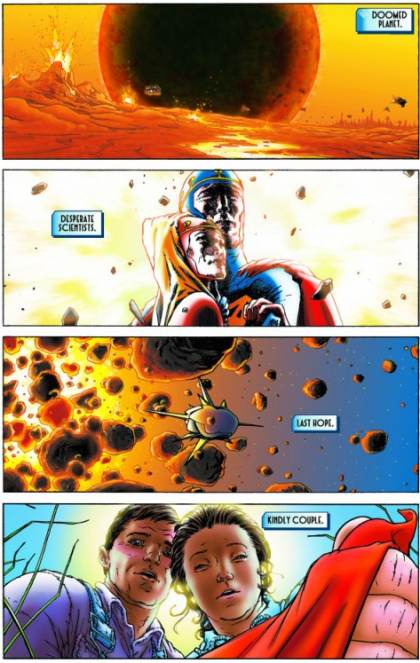 In my book, Superman is - in many ways - who Clark would be if he'd just been the human child of Martha and Jonathan Kent. Likely, he'd be a reporter who was maybe a bit overly persistent in his pursuit of investigative journalism. Superman may be smarter than that guy, and more damage resistant, but the core of who Superman is was set in his years between 1 and 18 by Jonathan and Martha.
But he wasn't that human child, and at some point he knew he was so different he became withdrawn, and the Clark Kent that we know was made - still with Jonathan and Martha's principles, but not sure how to deal with his classmates. How do you talk about the fact you coughed and knocked over a barn wall? That you accidentally saw Lana's underwear with your X-ray vision? That if someone pushes you in the hall, they're going to be pushing against a stone pillar?
Learning that he's Kal-El is freeing. It explains so much, but it also creates a new sense of responsibility for a whole culture, like suddenly learning he's a foreign exchange student from a country nobody really knows.
On Superman's audience
Yeah, Superman isn't for kids blasting Nu-Metal from their iPhone. Comics are full of characters for that demographic, and trying to make Superman work for the same audience that came to comics for The Punisher, Venom, Spawn, and (I hate to say it) Batman isn't going to work very well.
At this point in American pop-culture, Superman is seen as an Uncle who goes around telling kids to brush their teeth and get good grades, and that's square as hell, man. I'm not sure he was every actually like that in any medium, but I'm not going to deny the perception is out there.
Superman can be an aspirational character and not just a character who makes us comfortable wallowing in self-pity. It doesn't matter that he's incredibly powerful. Complaining that you can't imagine someone more powerful than Superman or who could challenge Superman says more about your lack of imagination as a writer than it does about 75 years of people who have given it a shot and succeeded.
What I don't think Superman needs is a killer edge to appeal to the audience that DC is courting.

Well said, Ryan. (Read his enitre post here).
Monday, February 25, 2013

Saturday, February 23, 2013
What can I say?
You are Superman
| You are mild-mannered, good, strong and you love to help others.  |
| ||||||||||||||||||||||||||||||||||
| Click here to take the "Which Superhero are you?" quiz... | |||||||||||||||||||||||||||||||||||
Thursday, December 06, 2012
Man Of Steel (of Nazareth?)

If there's an image that maybe can turn the perception of Superman on its ear, its the image of Superman in shackles surrounded by the minions of authority figures. It plays on a lot of ideas - not the least of which is that we automatically root for the misunderstood good guy (see Batman, Spider-Man, etc...), and we love to distrust and look down on the nitwits in positions of power - in the 80's it might have been corporate tycoons, but these days it seems "the guvernmint".
If a rockstar, rapper or actor gets street cred from trouble with the law, why not a Man of Steel? In a lot of ways, it makes far more sense, and it does go to Superman's roots. He can't have started as a duly deputized agent of the cops and friend to law everywhere. Is this the image that brings relevancy back to The Man of Steel for the pop culture pundits? Dark in tone as well as content, no smile, no circus-performer suit and the outsider status clearly front and center... it's like pop culture pundit catnip.I think he's right, but for me the poster also evokes powerful Christian imagery. The picture of Superman, who is essentially a God, humbled and led away in handcuffs, draws to mind the image of Jesus's arrest, trial, and ultimately his redemptive sacrifice. As a Christian, I confess I find this appealing, but Superman-Christian allegories, while not a huge stretch, tend to be way overstated. I think Superman's story is probably more Jewish, anyway. Did the producers have this in mind? I doubt it, but who knows? Either way, it's a great marketing ploy that will create lots of buzz, while giving a new audience an insight into the character and perhaps an understanding of his lasting appeal.
Wednesday, October 10, 2012
Looking back: The Dark Knight Returns

 For those who have yet to read TDKR, it takes place in Gotham City of the near future, perhaps ten years or so (from 1986). Superheroes have been outlawed, although it's unclear exactly why, something to do with a series of incidents that caused the public to become more fearful and distrustful of them). The government has become more powerful and authoritarian (Reagan is still holding onto the presidency). The United States in is still in the midst of the Cold War and tensions with the Soviets are nearing a breaking point. As the story begins, Batman has been retired for ten years. His enemies are safely locked up, but Gotham is worse than ever. A gang calling themselves the Mutants are terrorizing the city. Batman comes out of retirement to deal with them. But this Batman is older, meaner, and even more inclined to break the law. Lined up against him is not only the mutant gang, but the media and the public. As his war in Gotham escalates, it gets the attention of the federal government who dispatches Superman to deal with him.
The art is solid, if unspectacular and looks very unlike his artwork before or since. His lines are thin and numerous with a sketchy look to them. This is only enhanced by Klaus Janson, who takes a minimalist approach to inking. Lynn Varley's colors look like watercolor, very washed out but distinctive since the comic is very gray throughout. Visually, the book's strength is Miller's masterful panel by panel storytelling. The pages have a distinctly cinematic look, and he is able to effectively create pace, drama and action throughout.
The story does a great job of satirizing the shallow media-saturated culture of the 1980s that has only gotten worse in the years since, which is a big part of why the book is still compelling. But it doesn't stop there. Miller explores a number of themes, including the limits of law and order, vigilantism, freedom vs. security, chaos vs. order, anarchy, fascism, political correctness, the responsibility of individual citizens to maintain justice, the cost of compromising your values. The story asks what does it look like to be good in terrible world? Can we escape who we really are? Does violence, even if it's for a good cause, create more violence?
 What I appreciate most is that Miller doesn't seem to come down hard on any side of these issues. For example, his wonderful satirizing of pop psychology in the character of Dr. Wolper. On the one hand, Miller mocks the psycho-babble Dr. Wolper dispenses, like when he explains how Batman creates criminals. On the other hand, as the story unfolds, Batman's return clearly awakens the Joker and sparks an escalation of violence among would be vigilantes. Where is Miller on this issue? I think he respects his readers enough for them to sort that out themselves, which is why I still regard TDKR as one of the most intelligent comics ever written. Today, politics in comics are bluntly spelled out to us by a chorus of left-wing writers with no sense of subtly or respect for their audience.
In spite of Miller's ambiguity, fans and pundits still offer confident proclamations about the story's politics, as writer Mark Waid did when he declared the story was about liberalism vs. conservatism. Miller certainly uses the Cold War as a geopolitical canvas to tell his story, where the broader scope of Batman's thematic tensions play out. This is effective, but it tethers the story forever in the 80's. As does the goofy caricature of Ronald Reagan. I get the satire, but it comes across a little dated, and belies the story's sophistication.
 One of the legacies of The Dark Knight Returns is that it defined the characters of Superman and Batman for a generation. Batman is mean. Superman is nice. Batman is clever. Superman is simple. Batman is the realist. Superman is the idealist. Batman breaks the rules to get things done. Superman won't. Batman is cool. Superman's not. Batman won't back down to the man. Superman is the man. This interpretation, which is in my view a cursory take on the story, the characters and their relationship, is nevertheless the predominant perception held by fans and many creators.
This frustrates me because it idealizes Batman, and simplifies Superman. Miller's Batman is an angry PTSD-laden egomaniac, albeit a compelling one. But most fanboys like to think of Miller's Batman as a freedom fighting vigilante revolutionary. But unlike the character in Christopher Nolan's films, this Batman wants to force the world to conform to his vision. The people have allowed themselves be subjugated under an authoritarian government, and he believes it should be up to him and other superheroes to fix the world; to reshape it. He resents Superman for not only failing to use his vast powers to do this, but for surrendering his power and playing along.
 Bob Goodman, writer for the TDKR animated adaptation agrees, "Superman is not only working with no moral authority, He's on the wrong side." Personally, I like that Superman doesn't take this power into his hands. His restraint is part of why he's a hero in my view. Do we want people with fantastic powers to take over our politics and rob us of our self-determination just because they can? Unlike Batman, Superman understands people and societies cannot be forced to change. He would rather change people by his example; by doing good and helping others, but he must compromise himself in order do so, "I gave them my obedience and my invisibility. They gave me a license and let us live. No, I don't like it, but I get to save lives--and the media stays quiet." And for this, he's a stooge. And Batman's a hero. I dont' buy it. I don't think Miller does either.
Saturday, July 21, 2012
"Man of Steel" teaser trailer
Looks ...intriguing. Not what one would expect from a Superman trailer. It definitely implies a more serious, perhaps sober take on the mythos. I can't say I have anything to complain about other than I wish they showed a little bit more. The Russell Crowe (Jor-El) voice-over is effective. Another version playing in theaters has a Kevin Costner (Jonathan Kent) voice-over. I like that, much like the original 1978 film and Superman Returns, fatherhood is a prominent theme.
I sure hope they pull this off. If this bombs, there probably won't be another Superman movie for at least twenty years (or any other DC movie). It would be a shame for a generation of kids to lose out on what Superman meant for a lot of kids like me growing up. I liked Dirty Harry, Batman, and Arnold as much as the next kid, but their appeal was largely the catharsis of getting even, punishing bad guy and making him pay. Superman was always about doing what's right no matter what. He's about justice, mercy, self-sacrifice, faithfulness, responsibility and hope. In other words, Superman is an ideal. He is us at our best; what we all aspire to be. As my friend Ted says, "Superman could curb stomp the planet Earth if he wanted and make us all his slaves," but instead he chooses to serve the planet. And I think that goes a lot further than emptying a clip into a crook's chest or plunging your Adamantium claws through some poor Skrull.
Sunday, July 15, 2012

Thursday, March 29, 2012

Wednesday, February 22, 2012
Comic Delusion
So the other day I watched Secret Origin: The Story of DC Comics. It's a solid documentary. I learned some new things about DC's history and how the major comics and characters came to be. It also includes some great interviews with a number of different creators and their perspectives on superhero comics. Especially eye-opening was the strange personal life of Wonder Woman creator William Moulton Marston, and the S&M that was not so subtly displayed in the panels of the early Wonder Woman comics.
But what really stood out watching this documentary is the discussion over the direction of comics in the 1980s, focusing primarily on Frank Miller's The Dark Knight Returns and Alan Moore's Watchmen. Mark Waid, a great writer and someone who I have tremendous respect for as a creator, begins the discussion like this: "In the 80s, there's a whole new Conservative grip to the nation. Some of the younger comic book creators weren't too keen on that."
Apparently, to Liberals, having a Republican President represents a "Conservative grip" over the country. As they begin discussing The Dark Knight Returns, Waid goes on to describe his interpretation of the story as though it was the objective and widely accepted view: "The whole climax of the book ends up being Superman and Batman literally trading blows, as Batman reigns upon him with Kryptonite gloves, and really in that moment, you're seeing the fire of Liberalism pound the crap out of the staid Conservative era of the 1980s."
Please.
I've read numerous reviews, interpretations and discussions of The Dark Knight Returns, and that has to be most idiotic, simplistic mischaracterization of I've ever heard. Nowhere have I seen Miller's story described as an illustration of Liberal vs. Conservative worldviews. Most conspicuously, Miller himself has never characterized his book that way. I don't know if DC was trying to cling to a particular narrative during this portion of the documentary, or if these were Waid's actual views, but he presses on with this theme as the discussion moves to Alan Moore: "The whole concept of Watchmen is a reaction to Thatcher's England, that very Orwellian sense of government power, and sense of censorship, and sense of personal freedoms being curtailed."
Good grief. You'd think we were behind the Iron Curtain during the 80s. And when did Thatcher come to be viewed as such a tyrant? I guess helping to win the Cold War and defeating communism doesn't count for much these days.
Alan Moore (self-proclaimed anarchist), speaking at the time, describes his views this way: "It seems to me that anything these days which is slightly to the left of Ghengis Khan is immediately labeled as subversive. If, in this current time, tolerance and sensitivity of any kind are labled loony left or subversive than I would be quite proud to be considered a subversive." Wow. That's ballsy. And profound. To stand up to the fascist, authoritarian regimes of England and America during the dark, dystopian days of the 1980s took real courage. All I can say is, if the left-wing delusions of these writers help them create good comics, more power to them.
One other segment of the documentary left me mystified. While discussing the pathetic Death of Superman storyline, writer Louise Simonson actually moves herself to tears. No, not tears of shame, but of genuine sadness and mourning.
Really?
But what really stood out watching this documentary is the discussion over the direction of comics in the 1980s, focusing primarily on Frank Miller's The Dark Knight Returns and Alan Moore's Watchmen. Mark Waid, a great writer and someone who I have tremendous respect for as a creator, begins the discussion like this: "In the 80s, there's a whole new Conservative grip to the nation. Some of the younger comic book creators weren't too keen on that."
Apparently, to Liberals, having a Republican President represents a "Conservative grip" over the country. As they begin discussing The Dark Knight Returns, Waid goes on to describe his interpretation of the story as though it was the objective and widely accepted view: "The whole climax of the book ends up being Superman and Batman literally trading blows, as Batman reigns upon him with Kryptonite gloves, and really in that moment, you're seeing the fire of Liberalism pound the crap out of the staid Conservative era of the 1980s."
Please.
 |
| Take that, you right-wing stooge! |
I've read numerous reviews, interpretations and discussions of The Dark Knight Returns, and that has to be most idiotic, simplistic mischaracterization of I've ever heard. Nowhere have I seen Miller's story described as an illustration of Liberal vs. Conservative worldviews. Most conspicuously, Miller himself has never characterized his book that way. I don't know if DC was trying to cling to a particular narrative during this portion of the documentary, or if these were Waid's actual views, but he presses on with this theme as the discussion moves to Alan Moore: "The whole concept of Watchmen is a reaction to Thatcher's England, that very Orwellian sense of government power, and sense of censorship, and sense of personal freedoms being curtailed."
Good grief. You'd think we were behind the Iron Curtain during the 80s. And when did Thatcher come to be viewed as such a tyrant? I guess helping to win the Cold War and defeating communism doesn't count for much these days.
Alan Moore (self-proclaimed anarchist), speaking at the time, describes his views this way: "It seems to me that anything these days which is slightly to the left of Ghengis Khan is immediately labeled as subversive. If, in this current time, tolerance and sensitivity of any kind are labled loony left or subversive than I would be quite proud to be considered a subversive." Wow. That's ballsy. And profound. To stand up to the fascist, authoritarian regimes of England and America during the dark, dystopian days of the 1980s took real courage. All I can say is, if the left-wing delusions of these writers help them create good comics, more power to them.
One other segment of the documentary left me mystified. While discussing the pathetic Death of Superman storyline, writer Louise Simonson actually moves herself to tears. No, not tears of shame, but of genuine sadness and mourning.
Really?
Monday, February 06, 2012
Killing Superman
(Warning: some rough language)
This video has been making the rounds on the internet for the last week or so. Max Landis, son of movie director John Landis, has made this short film apparently to rant about his dislike for Superman. The young Landis focuses his drunken scorn for the Death (and Return) of Superman publicity stunt--er-uhh.. storyline from the early 1990s. The film's mocking, sarcastic tone wears thin pretty quickly, as does Landis's unconvincing Dean Martin act with an adult beverage and everything.
As a fan of Superman, I didn't find Landis's criticisms of the character particularly funny or original, but his lampooning of the Death of Superman crystallized the absurdity of the storyline, the pathetic lack of creativity of the writers and Editors at DC comics in the 90s. I can remember thinking at the time, "Is this the best they can do?" The whole thing was just so silly, uncompelling and uninspired, especially given this was the medium's flagship character, and how much DC was investing in the project. It just reinforced everything I disliked about DC at the time:
- Lame characters, outside the top 10 or so. Booster Gold?! Was Aqualad not available?
- Lame stories (i.e. lame writers)
- Lame art
Friday, August 05, 2011
The New "Man of Steel"
 |
| Click to enlarge |
Given that Zack Snyder (300, Watchmen, Sucker Punch) is directing this, I'm not very hopeful. Henry Cavill looks the part, I guess, but I wish they would have stuck with Brandon Routh. There no denying though, it's got a great cast. Kevin Costner and Diane Lane as Ma and Pa Kent, Amy Adams as Lois Lane, and Russell Crowe as Jor-El. As far as the photo, my initial thoughts are:
a) This looks more like a promotional photo rather than a still shot from the film.
b) That is a REALLY long cape. And...
c) The filmmakers really want to you to know this is a darker, more action-packed Superman movie; not a plodding, character driven film. In other words, it's not Superman Returns (which I liked a lot by the way).
What do you think?
Sunday, July 10, 2011
Deleted Opening Scene From Superman Returns
I'm generally not a fan of special edition movies with deleted scenes plugged in. The Lord of the Rings had some cool scenes that were added to its extended editions. Fanboys loved them, but the added cuts just made the movies longer and clunkier without really adding much the films themselves. In the case of Superman Returns, this deleted opening sequence adds a great deal to the movie by giving some needed detail and context to his departure and return to Earth. It also gives weight to a major plot point that is only afforded passing mention in the rest of the film.
Wednesday, April 06, 2011
Superman: Braniac

In my view, Superman is rarely done well, but writer Geoff Johns and penciler Gary Frank form a creative marriage that serves the Man of Steel well. As the title suggests, the story centers around the return of Braniac who sends his probes around the universe looking for civilized planets to steal knowledge from and promptly destroy, but only after shrinking and abducting a city from each one to keep as a specimen. As it turns out, these robotic probes are what Superman has been fighting all these years, not the real Braniac. One such robot comes to Earth. Superman promptly dispatches it, but not before the probe analyzes the Kryptonian's blood and sends the information to the real Braniac. Turns out, Braniac doesn't like the idea of someone out there sharing Kryptonian culture and science, which he believes now belongs soley to him. So naturally, Superman must be eliminated. Fearing Braniac's probes will destroy other planets, Superman goes searching the galaxy for the creature. Only problem, Braniac captures him and sends another probe to destroy the Earth.
The narrative is intriguing and moves quickly. Johns is one the few guys who seems to have a solid grasp on the Superman mythos. He has respect for the character, and it shows here. Superman and his world are recognizable, and casual readers will have no problem jumping into the story. The Braniac portrayed here is sort of a technological boogeyman who terrorizes the galaxy. He is genuinely creepy, somewhat reminiscent of the Borg in Star Trek. My only quibble with the story was a less than epic feel given what was at stake with the plot. I think there was room to go farther with the story and characters.
The visuals are supplied by former Hulk artist Gary Frank, and it's his best work yet. Frank was born to draw Superman. His art has a clean, clear quality to it, despite fine details. He also does what few artists can, which is to give every character his or her own unique face. None better than Superman himself who Frank renders in a near perfect likeness to Christopher Reeve. Frank fails in only one area. The layout, particularly the fight scenes between Superman and Braniac, is at times boring and uninspired. This hurts the dramatic weight of a story that wasn't very deep to begin with. All said however, Superman: Braniac is a satisfying read, and one of the better Superman stories.
Friday, March 25, 2011
Heroes Hollywood Can Live With
Perhaps the most symbolic character in the superhero pantheon, Captain America has been, ever since his creation in 1941, an unabashed symbol of American patriotism. So fans like me ought be rejoicing at the release of a new Captain America movie in July, right? Well, mabye. Last summer, director Joe Johnston had this to say about his protagonist :
He wants to serve his country, but he's not this jingoistic American flag-waver. He's just a good person...It'll be interesting and fun to put a different spin on the character and one that the fans are really going to appreciate...the idea that this isn't so much about America as it is about the spirit of doing the right thing. It's an international cast and an international story. It's about what makes America great and what makes the rest of the world great too.
This treatment is consistent with what seems to be a recent and ongoing trend to take popular characters who in one way or another project American ideals, and alter or mute those qualities to better reflect their own world view. A blogger over at Hot Air responds with an obvious question:
If you want to make a superhero movie, but you don't want to be troubled with the hair-raising spectacle of out-and-proud patriotism, why the hell would you choose Captain America? Choose Aquaman instead and have him deliver the requisite lecture about fearing "The Other."
In 2006, director Bryan Singer saw fit to drop the "the American way" from his film Superman Returns, content with his hero fighting for "Truth and Justice." Then in 2009, the popular 80s cartoon and comic book series G.I. Joe: A Real American Hero was adapted to the big screen and transformed from an elite U.S. Special Forces team to a "Brussels-based outfit that stands for Global Integrated Joint Operating Entity, an international co-ed force of operatives who use hi-tech weapons to battle Cobra." The result was a kind of CGI United Nations security force.
Filmmakers and studio execs maintain the reason for these changes are purely economic. They say the changes are based on concerns of brand management and consumer awareness. In other words, they are concerned about the success of their films in places where America is not popular. Understandable, given that foreign movie receipts have surpassed domestic profits (two-thirds of income for major Hollywood studios come from overseas). Movie critic Michael Medved points out "the growing importance of overseas fans plays into Hollywood's tendency to present a skeptical, and sometimes even hostile, motion picture attitude toward the U.S.A.."

The most recent victim of this "financial correctness" has to be the upcoming remake of the 80s Cold War classic Red Dawn. The new film, about an invasion from Red China, is now being altered because MGM has decided it doesn't want to offend one of its biggest potential markets. The studio has taken the extraordinary step of digitally erasing, from the already finished film, all references to China as the invading villains; substituting dialogue, removing images of Chinese flags and insignia. Daniel Foster over at Nation Review sums up the absurdity of the studio's decision:
And who are the new invaders? North Korea. That’s right, the starving-to-death, massively brainwashed “Hermit Kingdom.” I imagine at this very moment, Hollywood script doctors are working on a revised first act in which Kim Jong Il decides it’s a good idea to let hundreds of thousands of his captive countrymen travel to America.
For similar reasons, Captain America: The First Avenger is being marketed simply as The First Avenger in Russia, South Korea and the Ukraine.
The problem with the economic argument is that it's largely based on market research and focus groups rather than box office receipts. The evidence shows that American movies, even those with pro-American views make even more money overseas. Another problem with the economic argument is that it doesn't explain why studios throw money at movies with explicitly anti-American/anti-military messages (Rendition, In The Valley of Elah, The Kingdom, and Redacted); movies that portray America as the bad guy or equate the American military to terrorists. In other words, movies they know won't make money (and didn't). At the same time, they often block the production of pro-American/pro-military films. Why? Because in Hollywood, politics and the privilege to be invited to the right parties are every bit as powerful as profits. Unfortunately, the cost of these compromises on the art of filmmaking appears to be lost on much of the Hollywood community.
Not convinced? Any guess as to the top-grossing movie overseas going into this weekend? No, not Paul or The Lincoln Lawyer. It was the big, loud, thoroughly American, critically trashed, pro-military sci-fi action epic Battle: Los Angeles.
As far as Captain America is concerned, I'll reserve judgment until I actually see the film, but I can't help but think the director just doesn't get it when he says the movie is "about a guy who wants to do the right thing, and that transcends all nationalities and borders. He's going to do the right thing no matter what flag is on his chest." Wrong. Superman and Captain America have uniquely American values. They are a part of their nature, inseparable from their character, and the basis for their heroism. Writer/director Michael Wilson describes the attempt to globalize Superman like this:
The idea, I suppose, is to make the Man of Steel a savior for all the world, for the sake of being the savior for all the world. What the people behind this shift in mythology fail to understand is that Superman serves humanity BECAUSE of "the American Way," not in spite of it.

Thursday, May 04, 2006
Superman Returns
 Well, here's the new Superman trailer.
It looks pretty intruiging, but I liked the teaser trailer better.
Based on the response when I posted the teaser trailer before, I represent the minority of my friends who are excited about this movie. Some have said that Superman just isn't that interesting. Others have that superhero movies are getting to be old hat. Personally, I think a Superman movie can be very compelling because it deals with questions of how one can be good in a world that is evil. If the movie were being made by Jerry Bruckheimer and Michael Bay, I wouldn't bother, but since Bryan Singer (The Usual Suspects, X-Men, X2) is in the director's chair, there's reason to be excited. He's a fan of the original and wants to tell a good story. Besides, how good will Kevin Spacey be as Lex Luthor?
And while I agree that Superman has rarely been done well in comics, the first two movies were arguably the best superhero movies to date. Yes, the genre has been over-done as of late, with good and bad results, but I'm ready for one more good one - especially if its Superman.
Monday, February 14, 2005
What happened to Comic Books?
 I started collecting comics in about the 8th or 9th grade. Recently I was reminded how far things have changed for the worse when I picked up the newest issue of Superman (#212) at the bookstore. Superman has always been one of my favorites and even though I don't collect anymore, I still look for stuff I may enjoy. In this recent run of Superman, one of my favorite artists, Jim Lee, was drawing the book so I thought I'd take a look. What begins with Superman taking Lois Lane in his arms and flying off, ends with Mrs. Lane wrapped only in our hero's cape which barely covers and in some places accentuates her nude form. In the following panel she says to him, "Incredible. Just as mind-numbingly incredible as the first time." Then she looks over her shoulder with a sexy smirk and tells him "You really are something of a man of steel aren't you?" To which our hero cleverly remarks, "Glad you noticed."
Are you kidding me?
Thank you DC comics. You finally ruined comics. You finally ruined the last GOOD superhero. You corrupted Superman by turning his comic into a thinly veiled harlequin romance. Look, I'm not naive. I realize comics have become more gritty, sexier, with a bent towards realism, but why do I need to know about Superman's sex life? Is this why people read his comic? To watch the Last Son of Krypton get busy with Lois Lane and engage in silly pillow talk? Nevermind that it does not even make the slightest attempt to be ambigious should a younger reader pick it up.
Maybe I am naive.
In the late 70s and early 80s comics began to shift toward a more realistic product. This was done sporadically with certain characters in certain comics. Writers and artists who loved the characters as kids wanted to make their heroes accessbile to a modern audience and bring the stories up to date. I can remember one of the major shifts in the early nineties when many of the top artists left Marvel Comics and founded their own company, Image Comics. I remember at this time comics were starting to be more violent, outfits became tighter and skimpier, breasts got larger, but there were still some standards. The vast majority would still be appropriate for all age groups.
Since then, comics continue to be increasingly vulgar, violent, and sexualized. In a medium that was originally intended to tell fantastic/supernatural stories of good and evil to kids, the current product is completely inappropriate for kids.
And it goes beyond sex and violence. Writers and artists now seek to use comics as a vessel to relay their politics. Back in the 60s, Stan Lee created the X-men. The appeal of the X-men is that they were different, shunned and even hated by society. Many kids at one point or another could relate to X-men for this reason. Communicating values in story telling one thing. Politics is quite another.
 In 2003, Marvel restarted the Captain America series. It began with a post 9/11 story called The New Deal. In it Captain America is faced with the new threat of global terrorism. OK fine. I'm okay with seeing Cap putting the hammer down on some Islamo-Fascists the same way he did the Nazis in WWII. The story is shameful. Captain America finds himself trying to explain America's role in causing the 9/11 attacks. So now, readers are at the mercy of writers who use one the most beloved comic book characters as a platform to spout their leftist, anti-american politics.
I know comics have been marketed toward adults for a long time, but my question is at what point did comics stop marketing to kids altogether?
Batman and Wolverine always had room to be grittier and darker. But not Superman and Captain America. They're the boy scouts! Their appeal lies in their determination to stay true to their values.
Marvel and DC comics should be ashamed of themselves. Not only have they disregarded a sense of deceny in content and marketing, but they have fundamentally changed the character of the heroes that made them beloved by the public.
Subscribe to:
Posts (Atom)