Thursday, June 06, 2013

President Reagan's Speech on the 40th Anniversary of D-Day


President Ronald Reagan's Address commemorating the 40th Anniversary of D-Day at Normandy June 6, 1984 is one of the greatest speeches by one of the greatest orators of the 20th century.  Regardless of one's political views, can anyone deny, as demonstrated in this speech, that Reagan spoke with a warmth, sincerity and humanity virtually absent in our political leaders?  Certainly his oratory dwarfs that of his successors, Presidents George H.W. Bush, Bill Clinton and George W. Bush. President Obama has proven to be fine speaker and if you know me or read this blog, you will be surprised to know that I actually think President Obama gives very good nonpolitical speeches (few though they are).  If you doubt it, go watch at his speech at Tuscon after the Gabby Giffords shooting, or his speech at Ft. Hood following the shooting there, or his speech at the National Prayer Breakfast in 2011.   

But after watching the "Great Communicator," even Obama comes off as flat, even hollow.  I'm not trying to slight President Obama.  I just think Reagan was that good. He was so warm and genuine, it was hard not to like him.  If that sounds like partisan kool-aid Reagan worship, go watch his speeches, and recall he carried 44 states when elected, and 49 states upon reelection.  Think we'll ever see that again?  The point here is there are few people on Earth who could deliver a speech equal to the occasion of honoring the courage and sacrifice of those who landed on Normandy June 6, 1944. But Reagan did.  

Monday, April 22, 2013

Star Wars Anime


More proof that nearly anyone with talent can do Star Wars better than George Lucas. I'm not a fan of anime, and I certainly didn't think I would want it anywhere near Star Wars, but I gotta admit, this is pretty darn cool.

Friday, April 19, 2013

Charlie Chaplin speech from 'The Great Dictator'


A pretty amazing speech from from a guy known almost exclusively for his silent films. The Great Dictator was Charlie Chaplin's first talking picture, and his most commercially successful.  I had never even heard of this movie until a few days ago, but now I'd like to see it.  The film was released in 1940 when the United States was still formally at peace with Germany.  The Great Dictator is a allegorical take on Hitler's Germany, in which Chaplin mocks and condemns Hitler, Nazism, Mussolini and fascism.

Chaplin, who was not a Jew, plays a Jewish barber who looks just like the dictator of Tomania, Adenoid Hynkel.  Near the end of the movie, there is a mix up in which Hynkel is mistaken for the barber and arrested.  Consequently, the barber is forced to assume the identity of Hynkel.  He is taken to the capital where he must give a speech. His lieutenant Garbitsch, while introducing him to the crowd, decries free speech and calls for subjugation of the Jews.  The Barber gets up and delivers a stirring speech, calling for humanity to break free from dictatorships and use science and progress to make the world better instead.  Chaplin starred, wrote, produced, scored, and directed The Great Dictator.  I don't much about Chaplin, but I like that he used his popularity and clout to make a film that addresses the greatest threat of his day.

(Full disclosure: I swiped most of this summary of the film from Wikipedia.)

Thursday, April 18, 2013

Paul Revere's Ride 2.0

The British Are Coming!


Paul Revere's Ride
by Henry Wadsworth Longfellow

Listen my children and you shall hear
Of the midnight ride of Paul Revere,
On the eighteenth of April, in Seventy-five;
Hardly a man is now alive
Who remembers that famous day and year.
He said to his friend, "If the British march
By land or sea from the town to-night,
Hang a lantern aloft in the belfry arch
Of the North Church tower as a signal light,
One if by land, and two if by sea;
And I on the opposite shore will be,
Ready to ride and spread the alarm
Through every Middlesex village and farm,
For the country folk to be up and to arm."

Then he said "Good-night!" and with muffled oar
Silently rowed to the Charlestown shore,
Just as the moon rose over the bay,
Where swinging wide at her moorings lay
The Somerset, British man-of-war;
A phantom ship, with each mast and spar
Across the moon like a prison bar,
And a huge black hulk, that was magnified
By its own reflection in the tide.

Meanwhile, his friend through alley and street
Wanders and watches, with eager ears,
Till in the silence around him he hears
The muster of men at the barrack door,
The sound of arms, and the tramp of feet,
And the measured tread of the grenadiers,
Marching down to their boats on the shore.

Then he climbed the tower of the Old North Church,
By the wooden stairs, with stealthy tread,
To the belfry chamber overhead,
And startled the pigeons from their perch
On the sombre rafters, that round him made
Masses and moving shapes of shade,
By the trembling ladder, steep and tall,
To the highest window in the wall,
Where he paused to listen and look down
A moment on the roofs of the town
And the moonlight flowing over all.

Beneath, in the churchyard, lay the dead,
In their night encampment on the hill,
Wrapped in silence so deep and still
That he could hear, like a sentinel's tread,
The watchful night-wind, as it went
Creeping along from tent to tent,
And seeming to whisper, "All is well!"
A moment only he feels the spell
Of the place and the hour, and the secret dread
Of the lonely belfry and the dead;
For suddenly all his thoughts are bent
On a shadowy something far away,
Where the river widens to meet the bay,
A line of black that bends and floats
On the rising tide like a bridge of boats.

Meanwhile, impatient to mount and ride,
Booted and spurred, with a heavy stride
On the opposite shore walked Paul Revere.
Now he patted his horse's side,
Now he gazed at the landscape far and near,
Then, impetuous, stamped the earth,
And turned and tightened his saddle girth;
But mostly he watched with eager search
The belfry tower of the Old North Church,
As it rose above the graves on the hill,
Lonely and spectral and sombre and still.
And lo! as he looks, on the belfry's height
A glimmer, and then a gleam of light!
He springs to the saddle, the bridle he turns,
But lingers and gazes, till full on his sight
A second lamp in the belfry burns.

A hurry of hoofs in a village street,
A shape in the moonlight, a bulk in the dark,
And beneath, from the pebbles, in passing, a spark
Struck out by a steed flying fearless and fleet;
That was all! And yet, through the gloom and the light,
The fate of a nation was riding that night;
And the spark struck out by that steed, in his flight,
Kindled the land into flame with its heat.
He has left the village and mounted the steep,
And beneath him, tranquil and broad and deep,
Is the Mystic, meeting the ocean tides;
And under the alders that skirt its edge,
Now soft on the sand, now loud on the ledge,
Is heard the tramp of his steed as he rides.

It was twelve by the village clock
When he crossed the bridge into Medford town.
He heard the crowing of the cock,
And the barking of the farmer's dog,
And felt the damp of the river fog,
That rises after the sun goes down.

It was one by the village clock,
When he galloped into Lexington.
He saw the gilded weathercock
Swim in the moonlight as he passed,
And the meeting-house windows, black and bare,
Gaze at him with a spectral glare,
As if they already stood aghast
At the bloody work they would look upon.

It was two by the village clock,
When he came to the bridge in Concord town.
He heard the bleating of the flock,
And the twitter of birds among the trees,
And felt the breath of the morning breeze
Blowing over the meadow brown.
And one was safe and asleep in his bed
Who at the bridge would be first to fall,
Who that day would be lying dead,
Pierced by a British musket ball.

You know the rest. In the books you have read
How the British Regulars fired and fled,
How the farmers gave them ball for ball,
From behind each fence and farmyard wall,
Chasing the redcoats down the lane,
Then crossing the fields to emerge again
Under the trees at the turn of the road,
And only pausing to fire and load.

So through the night rode Paul Revere;
And so through the night went his cry of alarm
To every Middlesex village and farm,
A cry of defiance, and not of fear,
A voice in the darkness, a knock at the door,
And a word that shall echo for evermore!
For, borne on the night-wind of the Past,
Through all our history, to the last,
In the hour of darkness and peril and need,
The people will waken and listen to hear
The hurrying hoof-beats of that steed,
And the midnight message of Paul Revere.

Monday, April 15, 2013

"We have to break through our kind of private idea that kids belong to their parents..."


I don't even know what to say to this.  In a new ad from MSNBC, Melissa Harris-Perry explains her view of parenthood.  It says a lot about the network's relationship with reality that no one apparently thought this would be controversial.  Leaving aside the warped, insane idea that children belong to their community rather than their parents, and what that really means, let's just examine her contention that we don't invest enough in public education.  According to the Organisation for Economic Co-operation and Development, the United States spent, on all levels of public education, $15,812 per student in 2009.  That's the highest in the world.  State and local governments spent $859.9 billion on public education in 2010, according to the U.S. Census Bureau. That’s a 30.1 percent increase from $660.5 billion (adjusted for inflation) that the U.S. spent in 2000.

So if we followed Ms. Harris-Perry's advice and took a more collective view of children, we would... spend even more money?  Sorry -- "investments."  And that would make our schools better?  What could she possibly point to as evidence of this?  Parents understand perfectly well the community's role in the life of their children.  They live it everyday through their churches, schools, neighborhoods and civic organizations.  They don't need academics and government bureaucrats lecturing them from on high.

Sunday, April 14, 2013

"The Second Amendment is Bullshit"


I'm actually grateful to Bill Maher for saying what I suspect not an insignificant number of people on the left believe, but aren't quite willing to say aloud.  I made sure to use a clip that included the entire context of the conversation, so as to be fair and not go ape over a one-sentence soundbite (at 2:23).  I think the context is actually quite useful in showing what Maher and other like minded people would like to see, which is the elimination of most all guns in private hands like in many European nations.  In listening to the panel, it's clear they don't understand (and probably don't know any) gun owners/enthusiasts.  They paint a caricature of them that is colored with derision.  It's also evident that Maher, either doesn't understand (I think he does), or doesn't care about American history and its founding.  There is reasonable debate to be had over the meaning of the Second Amendment, but I think Maher's comments speak to the aspirations of so many on the left, who wish to see America transformed into a kind of egalitarian, government-centered society, that sheds those mores of the past which inhibit the state's power to bring about necessary change.   Back in 2001, President Obama expressed a similar sentiment over the limits placed on government by the Constitution.
To that extent, as radical as I think the people try to characterize the Warren Court, it wasn't that radical.  It didn't break free from the essential constraints that were placed by the Founding Fathers in the Constitution, at least as it's been interpreted, and the Warren Court interpreted it the same way, that generally the Constitution is a charter of negative liberties. Says what the states can't do to you. Says what the federal government can't do to you, but it doesn't say what the federal government or the state government must do on your behalf.
Some on my side have gone too far reading into this quote, but I think it accurately expresses the frustration of some on the left who would like to see the government take a more active role in establishing the kind of society they long for.  As a conservative, it's refreshing to see an issue in which the left is so out of step with the American people, and the frustration that they, their representatives in government and the news media, cannot move public opinion like they have on so many other issues like "the rich not paying their fair share" and gay marriage.

For good or for ill, Americans love their guns.  So much so that even the combined media blitz following Sandy Hook and the shameless demagoguing by the President failed to get any kind of "meaningful" gun control passed.  Even liberal politicians tread lightly on the issue because of their constituents.  Ever wonder why President Obama was utterly silent on gun control during his first four years or in the Presidential campaign?  He wanted to be reelected.  What's worse for liberals is that all this manufactured hysteria after Sandy Hook to get strict gun control passed has only served to make Americans more protective of their firearms; more wary of government efforts to curb their second amendment rights, and creating another a kind of hysteria to load up on guns and ammo.  Companies like Remington, Glock, and ATK having been running their factories 24/7 for months and STILL cannot keep up with demand.  So as a result of the left's barrage of outrage and push for government action (the "do-something disease") every time a crime or tragedy like Sandy Hook occurs, the gun companies they have so much contempt for are making money hand over fist.

If this issue proves anything, it is the power of representative government.  Since 1789, politicians have tried to bend, walk over, sneak by, or flat out ignore the Constitution. Thankfully, in spite their efforts, the will of the people still holds some sway in the halls of power in Washington, and that gives me some comfort, even if Bill Maher thinks it's bullshit.

Saturday, April 13, 2013

Wednesday, March 20, 2013

A Wild Horse

David Brooks of the New York Times is an interesting columnist.  A self-described moderate conservative, his opinions swing from one end of the political spectrum to the other, driving both conservatives and liberals crazy, depending on the day.  From my perspective, he sometimes drifts off the reservation, but about every third column, he really nails it.  Such is the case in his Monday editorial.  While the liberals and the media carp over the GOP being extremists, racists, out of touch and dying off as a party, Brooks brilliantly points out the bankrupt (literally and figuratively) philosophy of today's Democratic party.
There is a statue outside the Federal Trade Commission of a powerful, rambunctious horse being reined in by an extremely muscular man. This used to be a metaphor for liberalism. The horse was capitalism. The man was government, which was needed sometimes to restrain capitalism’s excesses.  
Today, liberalism seems to have changed. Today, many progressives seem to believe that government is the horse, the source of growth, job creation and prosperity. Capitalism is just a feeding trough that government can use to fuel its expansion. 
For an example of this new worldview, look at the budget produced by the Congressional Progressive Caucus last week. These Democrats try to boost economic growth with a gigantic $2.1 trillion increase in government spending — including a $450 billion public works initiative, a similar-size infrastructure program and $179 billion so states, too, can hire more government workers. 
 ...
Today, progressives are calling on government to be the growth engine in all circumstances. In this phase of the recovery, just as the economy is finally beginning to take off, these Democrats want to take an astounding $4.2 trillion out of the private sector and put it into government where they believe it can be used more efficiently.  
How do the House Democrats want to get this money? The top tax rate would shoot up to 49 percent. There’d be new taxes on investment, inheritance, corporate income, financial transactions, banking activity and on and on. 
 ... 
The progressive budget in the House seems to have been written by people hermetically sealed in the house of government. They work in government. They represent public-sector workers. They seem to have had little contact with private-sector job creators and no idea about what factors might play in their thinking. It’s a reminder that while Republicans may embarrass on a daily basis, many progressives have lost touch with what actually produces growth and prosperity.  
With Senate Democrats refusing to produce a budget since 2009 (nearly four years ago), Republicans included a provision in the January debt ceiling bill that forced the Senate to produce a budget or face a suspension of pay. Facing a threat to their income, Senate Democrats finally obliged. Their proposed budget eliminates the sequester cuts, raises taxes by $1 trillion and never balances the budget.  Today, the House rejected the Senate budget by a vote of 261-154.  The Congressional Progressive Caucus was also rejected 327-84.

Where's the President in all this?  He still hasn't proposed a budget, missing the deadline (February 4) for the third year in a row and for the fourth time in his presidency.

With Republicans disillusioned, stumbling around trying to find their identity, Democrats may think they have the future locked up.  But their innate and intransigent aversion to cutting even a penny of government spending means they will not turn away from the looming iceberg of unrestrained spending, unsustainable entitlements, and soaring debt.   In fact, the Democrats will steam straight for it, all the while claiming the iceberg will melt if the rich would just pay their fair share.

Wednesday, March 06, 2013

Finding Superman

I've had an affection for Superman going back to childhood.  I've never really attempted to formally articulate the basis for my admiration, but I think it's for the same reasons most people love the character.  Over the past 20 years, the comic book industry has become decidedly more adult and less kid friendly.  During that same time, Superman has increasingly come to be viewed as a square; the Richie Cunningham to Batman's Fonz.  DC has done little to alter that perception and seems to be increasingly confused about what to do with their flagship character.  I've griped and carped about this a few times without ever getting specific.  And now I don't have to.  Ryan over at The Signal Watch, my go-to Superman expert,  has done a masterful job reminding us why we love the character, as well as explaining the reasons for Superman's current place in the wilderness and what could be done to fix it.  Here are some highlights:

On Superman's supporting cast
There's a big focus in superhero comics these days wherein they characters only spend time with other superheroes after the origin story.  The Avengers only really talk to one another and SHIELD agents.  Batman only talks to Alfred and his cadre of masked young men, and Superman - even in the relaunch - only seems to talk to his 5th Dimensional neighbor and the Legion of Superheroes.

It sort of raises the question: what are any of these characters doing?  What are they fighting for?  What is the point of going out and putting on a cape if everyone you know is wearing the suit? 

I don't think Marvel had anything to lose in dumping the secret ID's of Captain America and Iron Man as those characters don't really need to hide their identity.  They're soldiers and captains of industry running around with personal arsenals.  Superman, however, isn't about tactical superiority, necessarily.  He's among us.  He's one of us.  Sure he took a job where he could be a crusading journalist by day to cover the news and understand the world (not it in his apartment and blog about stuff he saw on Reddit), but he's an alien who has a need to connect and share.  He made friends at The Planet, and that dynamic gave weight and import to the stories as something other than just people in tights punching one another.  He lived among us, and when we needed him, he stepped out of view long enough to change clothes and come save the day 
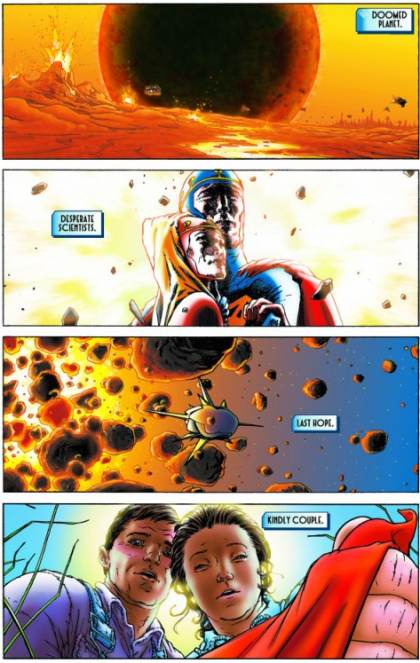
In so much of what you see in comics now, I have absolutely no idea what would be lost if the characters lost the day.  It's all secret ninja fights in dark alleys based on petty grudges.  Superman can be that from time-to-time, but the specialness of what a superhero is doing is dramatized not in another splashy spread on the page but in how that character is different from the unique personalities that surround him or her and what it means to be both friend and protector of that community.

On Superman as a socially conscious hero
Superman, when he was the only character in town, was unique as a sort of Robin Hood who didn't need to worry about getting arrested or beaten/ shot if he resisted while he went about doing what was right.  This went both ways, as we see in the first issue of Action where Superman defies the very governor of his state and saves someone about to be executed, and later takes on gangsters.  Both sides wield power, legitimate or otherwise, and Superman is beyond mortal concern when it comes to taking a stand or sticking up for the people who can't help themselves. 

For kids' stories, it's all pretty straightforward, but as comic shave grown into a medium for older readers, the better Superman stories explore what the implications are for exerting that power, and what effects it has from an intended and unintended standpoint.

On Lois Lane
She's also an integral part of why Superman needs Clark and needs to appear human. It's the only way to stick close to this remarkable woman until he can figure out how to better integrate his two lives.  Lois is the touchstone to what he sees in humanity that's worth saving - the spark of righteous indignation at injustice, the desire to set things right - it's what sets him out there in the cape and tights, to be the person to be the change that Lois wants to see.

On who Superman is
In my book, Superman is - in many ways - who Clark would be if he'd just been the human child of Martha and Jonathan Kent.  Likely, he'd be a reporter who was maybe a bit overly persistent in his pursuit of investigative journalism.  Superman may be smarter than that guy, and more damage resistant, but the core of who Superman is was set in his years between 1 and 18 by Jonathan and Martha. 

But he wasn't that human child, and at some point he knew he was so different he became withdrawn, and the Clark Kent that we know was made - still with Jonathan and Martha's principles, but not sure how to deal with his classmates.  How do you talk about the fact you coughed and knocked over a barn wall? That you accidentally saw Lana's underwear with your X-ray vision?  That if someone pushes you in the hall, they're going to be pushing against a stone pillar?

Learning that he's Kal-El is freeing.  It explains so much, but it also creates a new sense of responsibility for a whole culture, like suddenly learning he's a foreign exchange student from a country nobody really knows. 

On Superman's audience
Yeah, Superman isn't for kids blasting Nu-Metal from their iPhone.  Comics are full of characters for that demographic, and trying to make Superman work for the same audience that came to comics for The Punisher, Venom, Spawn, and (I hate to say it) Batman isn't going to work very well. 

At this point in American pop-culture, Superman is seen as an Uncle who goes around telling kids to brush their teeth and get good grades, and that's square as hell, man. I'm not sure he was every actually like that in any medium, but I'm not going to deny the perception is out there. 

Superman can be an aspirational character and not just a character who makes us comfortable wallowing in self-pity.  It doesn't matter that he's  incredibly powerful. Complaining that you can't imagine someone more powerful than Superman or who could challenge Superman says more about your lack of imagination as a writer than it does about 75 years of people who have given it a shot and succeeded. 

What I don't think Superman needs is a killer edge to appeal to the audience that DC is courting.


Well said, Ryan.  (Read his enitre post here).

Tuesday, February 26, 2013

Government at its "Platonic Ideal"


Great minds think alike.  I mentioned a couple days ago the sequester standoff will hurt President Obama and Democrats in the long term, because if the world is still here the morning after the sequester kicks in, their message that every dollar spent by the government is crucial and indispensable becomes hollow.  And that would be a catastrophe for the Democratic Party.  Yesterday on CNN, the venerable Charles Krauthammer said the same thing, only it sounded much better.

Sequestration Sobriety

Two days ago, I made the point that hysteria over sequestration cuts was unhinged from reality.  To believe a 2.4% cut of the increase in federal spending over the next ten years is calamitous, is to say that government can never be cut, EVER, under any circumstances.  The folks over at the CATO Institute have taken the numbers from the Congressional Budget Office and made a chart that puts the sequestration cuts in perspective.

You Stay Classy, Mr. President


With President Obama safely reelected, the news media, unburdened from having to provide cover for the White House, is now free to actually cover the White House. Among the first to take that bold step is the New York Times.  They reported this past Friday that President Obama has transformed his reelection campaign into an advocacy network with the goal of raising $50 million, which would make it one of Washington D.C.'s largest lobbying operations.  But,
Unlike a presidential campaign, Organizing for Action has been set up as a tax-exempt “social welfare group.” That means it is not bound by federal contribution limits, laws that bar White House officials from soliciting contributions, or the stringent reporting requirements for campaigns. In their place, the new group will self-regulate.
According to the Times, the new campaign, called Organizing for Action, will sell access to the White House for those who can pay.  Next month OFA is holding a "founders summit" where donors paying $50,000 each will get to mingle with top Obama aides.  But those with deeper pockets get access to the President himself. The Times reports,
Giving or raising $500,000 or more puts donors on a national advisory board for Mr. Obama’s group and the privilege of attending quarterly meetings with the president, along with other meetings at the White House. Moreover, the new cash demands on Mr. Obama’s top donors and bundlers come as many of them are angling for appointments to administration jobs or ambassadorships.
 And from shady, it starts to get sticky:
Many traditional advocacy organizations, including the Sierra Club and the National Rifle Association, are set up as social welfare groups, or 501(c)(4)’s in tax parlance. But unlike those groups, Organizing for Action appears to be an extension of the administration, stocked with alumni of Mr. Obama’s White House and campaign teams and devoted solely to the president’s second-term agenda. 
 Change we can believe in?

Monday, February 25, 2013

Superman by Jae Lee

Media Malpractice


Shortly after the 2008 presidential election, Libertarian radio talk show host John Ziegler produced a documentary chronicling what he saw as the biased news coverage that propelled Barack Obama to the Presidency.  I had this documentary in my Netflix cue for probably two years.  I avoided it for two reasons. One, I knew watching it would bring back all my frustrations and anger about the news media's behavior in 2008.  Two, I didn't want to watch an overly partisan, echo chamber-style documentary.  But since President Obama's reelection, the news media has been on my mind a lot, and I decided to give the film a tumble (unfortunately, it's no longer available streaming).  I use the term documentary loosely.  I still remember those innocent days when we assumed documentaries were by nature objective, or tried to be.

But for good or for ill, Michael Moore changed that and filmmakers of all political persuasions have followed his lead.  I actually don't mind politically oriented documentaries, but I think they ought to be called something else.  Too many people hear "documentary" and assume an unbiased enterprise.  Can anyone really say Bowling for Columbine or Fahrenheit 9/11 are unbiased ?  Hollywood makes this distinction, but only when the documentary's bias suits them.  For example, Davis Guggenheim produced and directed An Inconvenient Truth, which won the Academy Award for Best Documentary in 2006.  Guggenheim is a big liberal.  Last year, President Obama tapped him to direct his 17-minute reelection film, The Road We've Traveled.*  But not even Guggenheim, the man behind the Magna Carta of left-wing environmental doctrine, was safe when he dared to wander off the liberal reservation.  In 2010, he produced and directed a truly outstanding nonpolitical documentary, Waiting For Superman that was critical of, among other things, teacher's unions as a barrier to educational reform.  If you haven't seen it, stop here and go watch it right now and decide for yourself.  It's currently available streaming on Netflix.  Despite near unanimous praise from critics and viewers from all over the political spectrum, WFS wasn't even nominated. Why?  There were alleged inaccuracies.  Interesting that the Academy was suddenly so scrupulous in vetting its documentaries.  Did they run Fahrenheit 9/11 or An Inconvenient Truth through the fact checker before nominating them?

Back to Media Malpractice.  I'll start with the negative.  It's a pretty low budget documentary, not that it needs a lot bells and whistles.  It's made up almost entirely of news footage and a few interviews.  But the music is kind of rinky-dink and seems out of place at times.  There's several segments of Ziegler's media appearances to promote the film's release that are totally unnecessary.  But the biggest problem is the inclusion of an interview with Sarah Palin that is the centerpiece of the film.  The interview is really not necessary and in my view, works against, or at least distracts from the purpose of the film.  A few words about Sarah Palin.  I'm not a fan.  I  don't dislike her.  I just think she is an ineffectual and distracting voice in the Republican Party.  It's not entirely her fault.  The media has made her into such a toxic and divisive figure, she can no longer be effective. And in my view, she has made it worse in the intervening years by becoming a pundit, publicly inserting her opinion into every issue and embracing her celebrity among the right.  There is no doubt, as the film, documents, the media savaged her unfairly, but her presence in the film, reacting to footage she has never seen, and trying to explain her poor performances in interviews with Katie Couric and Charlie Gibson makes her look like a victim.  And even though I felt bad for her, the fact is that in politics, looking like a victim, even if you are one, makes you look weak.  And that's what comes across in the interview.   It was uncomfortable at times, watching her react to some of the cruel and outrageous things said about her and her family, but distracting.  The film would have been more effective without her (and shorter).

Having said that, the film still largely works because it relies primarily on news footage, and aside from narration to give context, it lets the media speak for itself.  Most of the film is designed to show the contrast in news coverage of Barack Obama versus that of John McCain and Sarah Palin.  But it also shows how the news media attacked liberal heroes like Bill Clinton and Geraldine Ferraro when they dared to criticize their chosen one.  In other words, the bias went far beyond adoring coverage of Obama.  It repeatedly covered for him when he came under criticism, sought to diffuse or ignore any damaging information that surfaced.  Another thing that is clear from the footage is how little vetting of Obama there was.  Any mention of potentially damaging actions, quotes, relationships or associations from his past were met accusations of racism, dirty politics, or focusing on things that don't matter.  Whereas with Palin, nothing was out of bounds.  Hordes of reporters descending on Wasilla, AK.  Her family, her wardrobe, her every word was the object of scorn and ridicule.  And what of Joe Biden's almost daily gaffes and idiot prone behavior?  Nothing. Even after four years, it's shocking.

The films ends with a series of interviews with twelve Obama voters chosen at random from a voting precinct on election day.  The director asks a series of questions about the the different candidates.  What the results showed is that the voters knew every negative, even petty thing about McCain and Palin, but little or nothing of the issues, and were virtually unaware of any story that reflected negatively on the Obama-Biden ticket.  The purpose of the segment was not to show that Obama voters were somehow stupid (one was a Cal Berkeley grad), but that their knowledge of politics was a  perfect reflection of what the news media offered.  It's an effective scene.

For what it is, it's a decent film, and worth watching if for no other reason than to remind us why we need a press that behaves professionally and has some regard for fairness, objectivity and accuracy.


* Narrated by the reassuring baritone of Tom Hanks, The Road We've Traveled is the gospel of Barack Obama as told by his apostles.  In this gospel, Obama, a man only in the scientific sense, single-handedly saved us from the abyss in 2009, and gave us four years of unprecedented virtue and prosperity.  And if we're brave enough; if we as a nation can bring ourselves to be worthy of his leadership, he is willing to be our President for another four years.